Choosing the right rubber flooring is an important part of planning a commercial gym, fitness studio, weight room, or training facility.
While thickness and material quality are important, there is another decision that should not be overlooked:
Should you choose rubber flooring rolls or rubber flooring tiles?
Both options can provide durability, impact protection, traction, and easy maintenance. However, they are designed for different project requirements.
In this guide, we compare rubber flooring rolls and tiles to help you choose the right solution for your gym project.
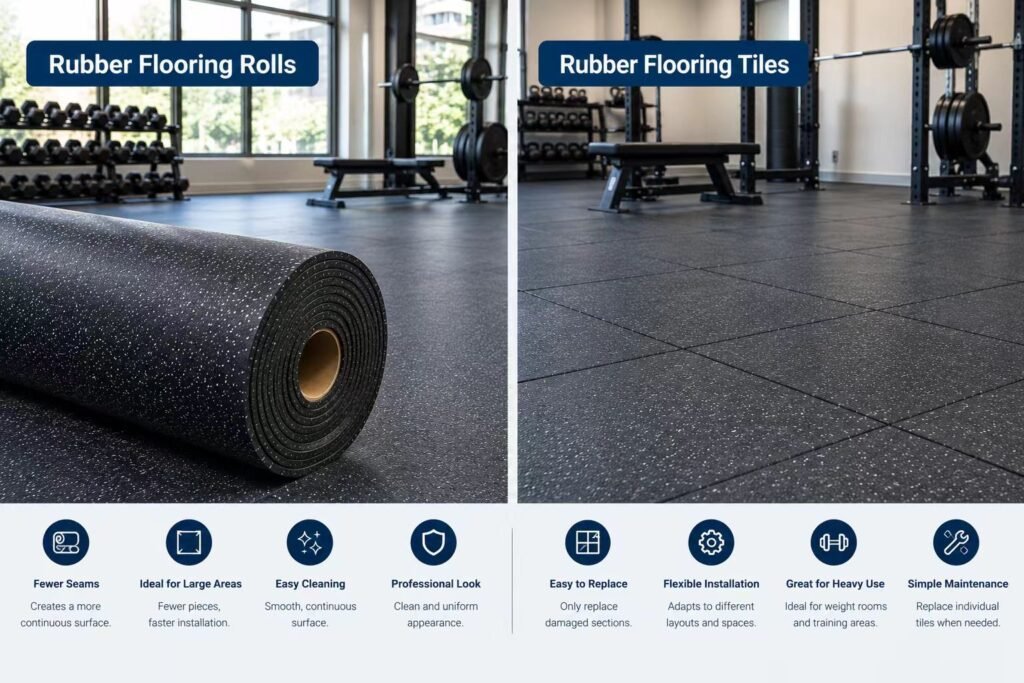
Rubber Flooring Rolls
Rubber flooring rolls are continuous sheets of rubber flooring supplied in large rolls.
They are commonly used in large and open areas where a clean, consistent floor surface is preferred.
Advantages of Rubber Flooring Rolls
- Fewer seams
Because rolls cover a larger area with fewer joints, they can create a more continuous and uniform appearance.
This can be particularly useful for large commercial gyms, fitness centers, and training rooms. - Efficient for large areas
When you need to cover a large open floor, rolls can reduce the number of individual pieces that need to be installed.
This can help create a more consistent flooring layout. - Easy daily cleaning
The relatively continuous surface can make routine sweeping, vacuuming, and mopping easier.
This is especially useful in busy commercial fitness facilities where the flooring needs to be cleaned frequently. - Professional appearance
Rubber rolls provide a clean and uniform appearance, making them suitable for commercial gyms, fitness studios, and other professional training environments.
Rubber Flooring Tiles
Rubber flooring tiles are individual pieces that can be installed together to cover a larger floor area.
Interlocking rubber tiles are also available for some applications, making installation and replacement more convenient.
Advantages of Rubber Flooring Tiles
- Easy to replace individual sections
One of the biggest advantages of tiles is that damaged or heavily worn sections can often be replaced individually.
This can be useful in gyms where certain areas receive much higher impact than others.
For example, a weightlifting area may experience more impact than a cardio area. - Flexible installation
Tiles can be useful when working with rooms that have different layouts or specific floor areas.
They can also be easier to handle during installation compared with large rolls. - Suitable for heavy-duty areas
Rubber tiles are commonly used in strength training areas, weight rooms, functional training zones, and other areas where impact protection is important. - Easier local maintenance
If a small section of flooring needs to be replaced, you may not need to remove the entire floor.
This can make long-term maintenance more convenient for some commercial facilities.
Which Rubber Flooring Is Better for a Commercial Gym?
For a large commercial gym with extensive open floor space, rubber flooring rolls can be a practical option.
They provide a more continuous surface and can work well for large cardio areas, general fitness spaces, and training rooms.
For areas where flooring may experience concentrated impact, rubber tiles can provide additional flexibility because individual sections can be replaced when necessary.
For example:
Cardio areas: Rubber rolls can be a practical choice.
General fitness areas: Both rolls and tiles can work well.
Functional training areas: Choose based on impact level and layout.
Weightlifting areas: Heavy-duty rubber tiles or thick rubber rolls may be suitable.
High-impact zones: Consider thicker rubber flooring and additional protection where required.
The flooring format should always be considered together with thickness, rubber quality, equipment, and expected impact.
What Should You Consider Before Ordering?
Before choosing rubber rolls or tiles, consider the following questions.
- How large is the project?
Large, open areas may benefit from rubber rolls, while smaller or divided spaces may be easier to install using tiles. - What activities will take place?
A cardio studio has different flooring requirements from a heavy weightlifting area.
Consider equipment weight, foot traffic, dropped weights, and training intensity. - Will the flooring need to be replaced in sections?
If localized replacement is important, rubber tiles can provide more flexibility. - What thickness do you need?
Flooring format should not be considered separately from thickness.
As discussed in our rubber gym flooring thickness guide, different areas may require different thicknesses depending on impact and equipment. - What is the condition of the existing floor?
The subfloor should be relatively clean, stable, and suitable for the selected flooring system.
Any major unevenness or damage should be addressed before installation.
Final Thoughts
There is no single rubber flooring solution that is perfect for every gym.
Rubber flooring rolls are often a practical choice for large, open areas where a continuous and uniform surface is preferred.
Rubber flooring tiles can offer greater flexibility for installation, maintenance, and localized replacement.
The best choice depends on your gym layout, training activities, impact level, flooring thickness, and long-term maintenance requirements.
If you are planning a commercial gym, fitness studio, weight room, or other sports flooring project, Stardway Sports can provide different rubber flooring formats and specifications to match your project requirements.
Contact us to discuss your project, request product specifications, or get a quotation.
FAQ
Are rubber rolls better than rubber tiles for gyms?
Not necessarily. Both can be suitable for gyms. Rolls are often practical for large open areas, while tiles can offer easier localized replacement and installation flexibility.
Are rubber tiles good for weightlifting areas?
Yes. Heavy-duty rubber tiles can be suitable for weight rooms and strength training areas, especially where impact resistance and localized replacement are important.
Are rubber flooring rolls suitable for commercial gyms?
Yes. Rubber rolls can be a practical solution for large commercial gym areas, cardio zones, fitness studios, and general training spaces.
Which is easier to replace, rubber rolls or tiles?
Rubber tiles are generally more convenient when only a small section needs to be replaced because individual tiles can be removed and replaced.
How do I choose between rubber rolls and tiles?
Consider your floor area, gym layout, training activities, impact level, required thickness, installation method, and future maintenance needs before making a decision.