Planning a new gym or replacing an old floor? One question usually comes up before the order is placed:
How much rubber flooring do I actually need?
It sounds simple, but ordering too little can delay a project, while ordering too much means paying for material you may never use.
Here is a simple way to work it out.
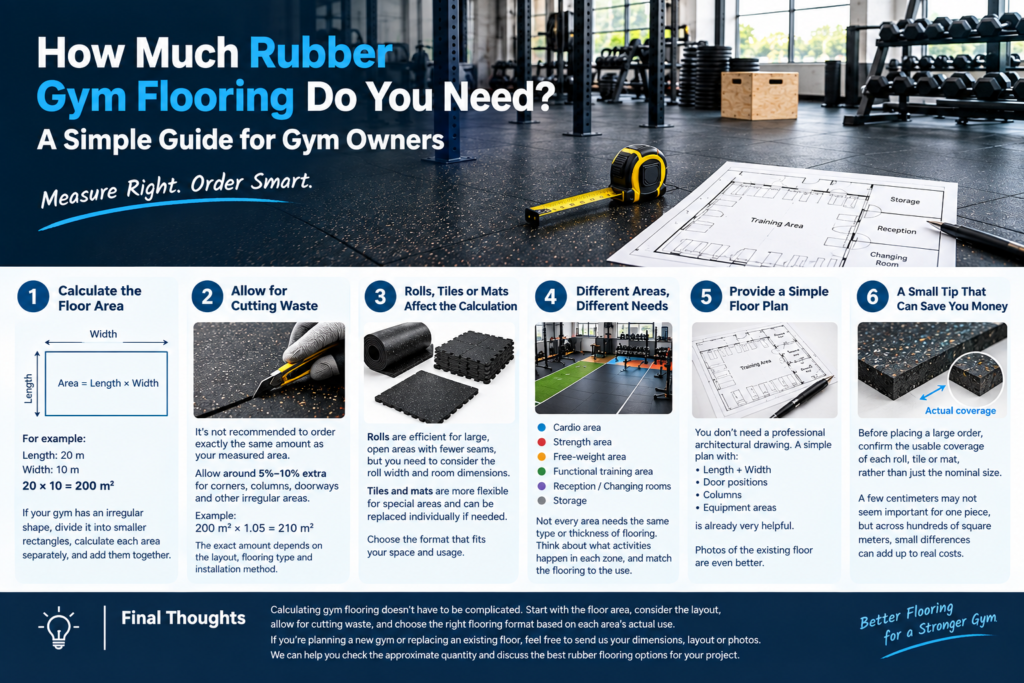
1. Start with the floor area
For a simple rectangular room, the calculation is easy:
Length × Width = Floor Area
For example, if your training area is:
- Length: 20 m
- Width: 10 m
Then:
20 × 10 = 200 m²
So you need to cover approximately 200 square meters.
For an irregular-shaped gym, divide the space into smaller rectangles, calculate each area separately, and add them together.
2. Don’t forget cutting waste
You normally shouldn’t order exactly the same amount as your measured floor area.
Corners, columns, doorways and other shapes can create offcuts during installation. A small extra allowance can help avoid the problem of running short at the end of the project.
For a simple installation, buyers often allow around 5–10% extra material, but the actual amount depends on the room layout, flooring format and installation method.
For example:
200 m² × 1.05 = 210 m²
So a 200 m² project might be planned around 210 m² of material.
The exact quantity should still be confirmed with your flooring supplier before placing the order.
3. Rolls, tiles or mats can change the calculation
The total floor area is only part of the calculation.
The size and format of the rubber flooring also matter.
Rubber rolls can be efficient for large, open areas because there are fewer joints. But the roll width and room dimensions need to be considered carefully when planning the layout.
Rubber tiles and mats are easier to work around certain areas and can be useful when you want to replace individual pieces later.
For example, a gym may use rolls in a large cardio or training area while using thicker rubber mats around free-weight or equipment zones.
There isn’t one format that works for every gym.
4. Don’t automatically cover every square meter
This is something worth thinking about before ordering.
A gym may have several different areas:
- Cardio area
- Strength training area
- Free-weight area
- Functional training area
- Reception
- Changing rooms
- Storage
Not every area necessarily needs the same type or thickness of rubber flooring.
Instead of simply measuring the entire building, look at what happens in each area.
Where there are heavy weights, repeated impacts or heavy equipment, flooring requirements may be different from a quiet stretching or walking area.
5. Give your supplier a simple floor plan
If you’re buying rubber flooring for a commercial gym, you don’t need to send a perfect architectural drawing just to get a preliminary quotation.
A simple floor plan with:
Length + Width + Door Positions + Columns + Equipment Areas
is already very useful.
Even better, send photos of the existing floor together with the measurements.
A flooring supplier can then help check the quantity, flooring format and possible cutting issues before production.
A Small Tip That Can Save You Money
Before placing a large order, ask the supplier to confirm the usable coverage of each roll, tile or mat, rather than calculating everything from the product’s nominal size alone.
A few centimeters may not sound important when you’re looking at one piece.
But across hundreds of square meters, small differences can become a real cost.
And if you’re ordering from overseas, it is much easier to solve a quantity problem before production than after the container has left the factory.
Final Thoughts
Calculating rubber gym flooring doesn’t have to be complicated.
Start with the floor area, consider the layout, allow for cutting waste, and then choose the flooring format based on how each area will actually be used.
If you’re planning a new gym or replacing an existing gym floor, you can send us your floor dimensions, layout or photos. We can help you check the approximate quantity and discuss suitable rubber flooring options before you place an order.