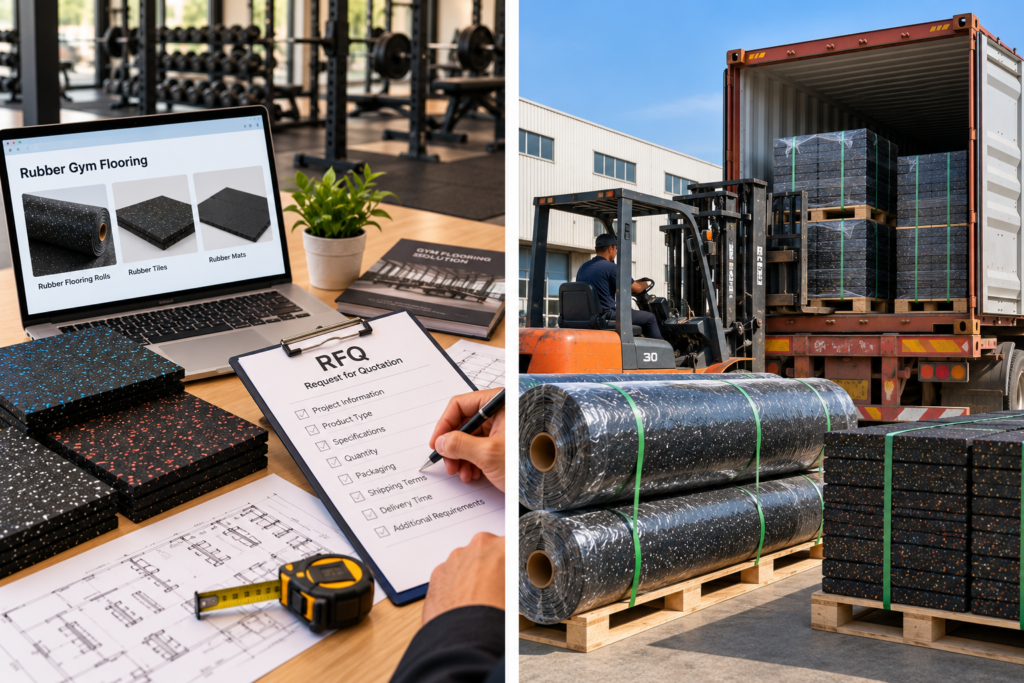
Importing rubber gym flooring from China can be an option for gym equipment distributors, flooring wholesalers, commercial gym contractors, and fitness facility owners looking to source products for larger projects.
However, an international purchase involves more than selecting rubber mats or comparing prices. Buyers also need to coordinate product specifications, shipping arrangements, import documentation, customs requirements, and delivery schedules.
Understanding these steps before placing an order can help reduce confusion and make communication with your supplier more efficient.
This guide explains the main considerations when planning to import rubber gym flooring from China.
1. Define Your Import Requirements Before Contacting Suppliers
Before requesting a quotation, prepare a clear description of your purchasing requirements.
Start with the type of flooring you intend to import. Common formats include rubber flooring rolls, rubber tiles, and individual rubber mats.
Your inquiry should identify:
- Intended application, such as a commercial gym or fitness studio
- Preferred flooring format
- Required dimensions and thickness, if already specified
- Color and surface appearance preferences
- Estimated order quantity
- Destination country and delivery location
- Expected project or purchasing schedule
If you are importing for distribution rather than a single project, explain whether you need a particular packaging arrangement or product identification system.
The more clearly you communicate your requirements, the easier it becomes for suppliers to prepare a relevant quotation.
2. Confirm Product Details and Documentation
Before confirming a bulk order, make sure the quotation identifies the exact product being offered.
Ask the supplier to confirm available specifications, order units, packaging arrangements, and any applicable product documentation.
If your destination market or project requires particular testing, labeling, or performance information, identify those requirements early.
For example, certain projects may require documentation relating to fire behavior, slip resistance, or other performance characteristics.
Requirements vary by destination and application. A product description alone does not establish compliance with a particular country’s regulations or a project’s technical specification.
Request documentation that clearly identifies the relevant product, test conditions, and scope of any stated result.
Do not assume that every rubber flooring product from the same manufacturer has identical performance characteristics.
3. Understand International Shipping Terms
Shipping terms are an important part of international purchasing because they determine which responsibilities and costs belong to the buyer and seller.
International quotations may refer to Incoterms such as EXW, FOB, CIF, or DAP.
These terms have specific meanings under the applicable Incoterms rules, and their use should be confirmed in the sales agreement.
EXW and FOB
Under EXW, the seller makes the goods available at the agreed location, while the buyer takes on extensive transport responsibilities.
FOB is used for sea or inland waterway transport and involves delivery of the goods on board the vessel at the named port of shipment.
The appropriate term depends on the shipping arrangement. Buyers should confirm the named location, applicable Incoterms edition, and division of responsibilities.
CIF and DAP
CIF is another term used for sea or inland waterway transport. It includes specified seller obligations relating to freight and insurance, but buyers should not assume it means the seller bears every risk until arrival.
DAP can be used for different transport modes and addresses delivery at a named destination, subject to the responsibilities defined by the term.
Before comparing quotations, ask suppliers to identify the exact delivery term and named place.
A lower product quotation may not represent a lower overall import cost if the shipping responsibilities differ.
4. Prepare for Customs Clearance
Customs procedures are determined by the importing country and the classification of the goods.
Depending on the destination, an importer may need documents such as:
- Commercial invoice
- Packing list
- Transport document, such as a bill of lading
- Customs declaration information
- Origin documentation, where required
- Product-related compliance documents, where applicable
The exact requirements depend on the destination, shipment, and applicable regulations.
Check the Product Classification
Rubber flooring products should not automatically be assigned a customs classification based only on a general product name.
The correct classification may depend on the product’s composition, construction, and intended use, as well as the importing country’s tariff rules.
Ask your customs broker or relevant customs authority to confirm the appropriate classification before calculating duties.
Understand Import Duties and Taxes
Import duties, value-added tax, sales tax, and other charges may apply depending on the destination.
These costs should be reviewed using current official information for the importing country.
Do not rely on a supplier’s general estimate as the final determination of customs charges.
5. Calculate the Total Landed Cost
For B2B buyers, the product price is only one part of the purchasing decision.
A landed-cost estimate may need to include:
- Product purchase price
- Export-related charges allocated to the buyer
- International freight
- Cargo insurance
- Customs duties and applicable taxes
- Customs brokerage fees
- Destination handling and local transportation
- Other charges relevant to the agreed delivery terms
Not every cost applies to every transaction, and some may already be included in the supplier’s quotation.
To avoid double counting, first identify which costs are covered by the agreed Incoterm and commercial contract.
Then calculate the remaining costs using quotations from the relevant logistics providers and current customs information.
This approach helps buyers compare offers on a more consistent basis.
6. Plan Production and Delivery Timing
International orders involve several stages that can affect the overall schedule.
These may include order confirmation, production, inspection or documentation arrangements, packaging, transportation, customs clearance, and final delivery.
Ask your supplier to clarify the estimated production lead time and the point at which the goods are expected to be ready for shipment.
For the transportation stage, consult your freight forwarder or carrier for a current estimate.
Allow time for documentation checks and possible changes to transportation schedules.
If your rubber flooring is intended for a gym opening or renovation project, coordinate purchasing dates with the installation team.
Avoid treating estimated production or transit times as guaranteed delivery dates unless they are explicitly agreed under the relevant contract.
7. Establish Clear Communication Before Payment
Clear written communication can help prevent misunderstandings during an international order.
Before confirming payment arrangements, review the commercial documents and make sure the important details are consistent.
Check the following information:
- Buyer and seller identification
- Product descriptions and specifications
- Ordered quantities and units
- Agreed prices and currency
- Payment terms
- Delivery terms and named locations
- Estimated production schedule
- Packaging requirements
- Procedures for resolving discrepancies
Keep the final confirmed documents available to the people responsible for purchasing, logistics, and receiving the shipment.
If anything remains unclear, request written clarification before proceeding.
8. Coordinate Receiving and Post-Delivery Records
Import planning should also include what happens after the shipment arrives.
Assign responsibility for checking the shipment against the confirmed order and available shipping documents.
Record package counts, visible packaging conditions, and any discrepancies that require clarification.
Follow the carrier’s, supplier’s, and applicable contractual procedures for reporting concerns.
Receiving records can help the purchasing and project teams communicate clearly, but they do not replace technical product inspections or establish legal acceptance requirements.
Import Rubber Gym Flooring with Better Preparation
Importing rubber gym flooring from China requires coordination between product purchasing, international logistics, customs clearance, and project planning.
For distributors, wholesalers, and commercial gym buyers, a clear purchasing process can make these responsibilities easier to manage.
At Stardway Sports, we welcome inquiries from international buyers looking for rubber flooring products for fitness and commercial projects.
Explore our rubber flooring rolls or visit the Stardway Sports website to learn more about our product range.
When contacting us, share your destination country, estimated order quantity, preferred flooring format, and intended application. Our team can discuss available product options and the information needed to prepare your inquiry.