Choosing the right rubber gym flooring thickness is important when planning a new gym or fitness area. Different areas deal with different levels of impact, so the same thickness does not always work for every space.
Here is a simple guide to help you choose.
How Thick Should Rubber Gym Flooring Be?
The right thickness mainly depends on what happens on the floor.
8–10 mm: Cardio and General Fitness Areas
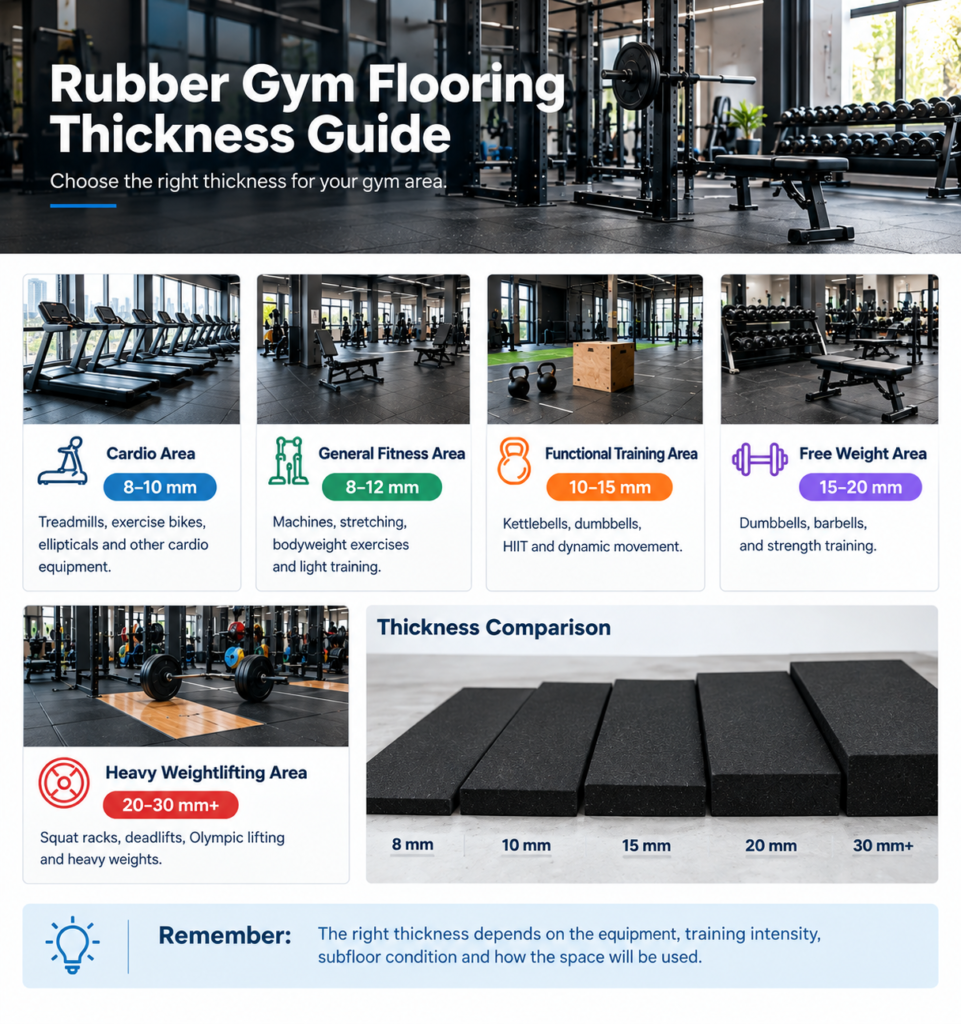
For areas with treadmills, exercise bikes, machines, stretching, and general workouts, 8–10 mm rubber flooring is often a practical choice.
It provides good durability and floor protection without adding unnecessary cost.
10–15 mm: Functional Training
Functional training areas usually see more movement and impact.
If the space is used for kettlebells, dumbbells, HIIT workouts, or other active training, 10–15 mm rubber flooring can provide extra protection and a more comfortable surface.
15–20 mm: Free Weight Areas
Free weight areas need more protection because dumbbells and barbells can be dropped during training.
For these areas, 15–20 mm rubber flooring is a common choice for commercial gyms and strength training spaces.
20–30 mm+: Heavy Weightlifting
Heavy lifting puts the most stress on gym flooring.
If your gym has squat racks, deadlift areas, Olympic lifting, or heavy bumper plates, 20–30 mm or thicker flooring may be a better option.
For very high-impact areas, dedicated lifting platforms or additional protection may also be worth considering.
Does Thicker Always Mean Better?
Not necessarily.
A thicker floor can provide more impact protection, but you do not always need the thickest rubber flooring throughout the whole gym.
For example, a cardio area usually does not need the same flooring as a heavy weightlifting area.
For commercial projects, it often makes more sense to choose the thickness based on how each area will actually be used.
What Else Should You Consider?
Thickness is important, but it is not the only thing to look at.
Before ordering rubber gym flooring, consider:
- What equipment will be used?
- Will heavy weights be dropped?
- How often will the gym be used?
- What condition is the existing floor in?
- Do you need rubber tiles, mats, or rolls?
The right combination of thickness, rubber quality, and flooring format will give you a better result than simply choosing the thickest option.
Need Help Choosing the Right Rubber Gym Flooring?
If you are planning a gym project and are not sure which thickness is right for your application, feel free to contact us.
We can recommend suitable rubber flooring based on your gym area, equipment, thickness requirements, and project size.
Contact us for more information or a quotation.